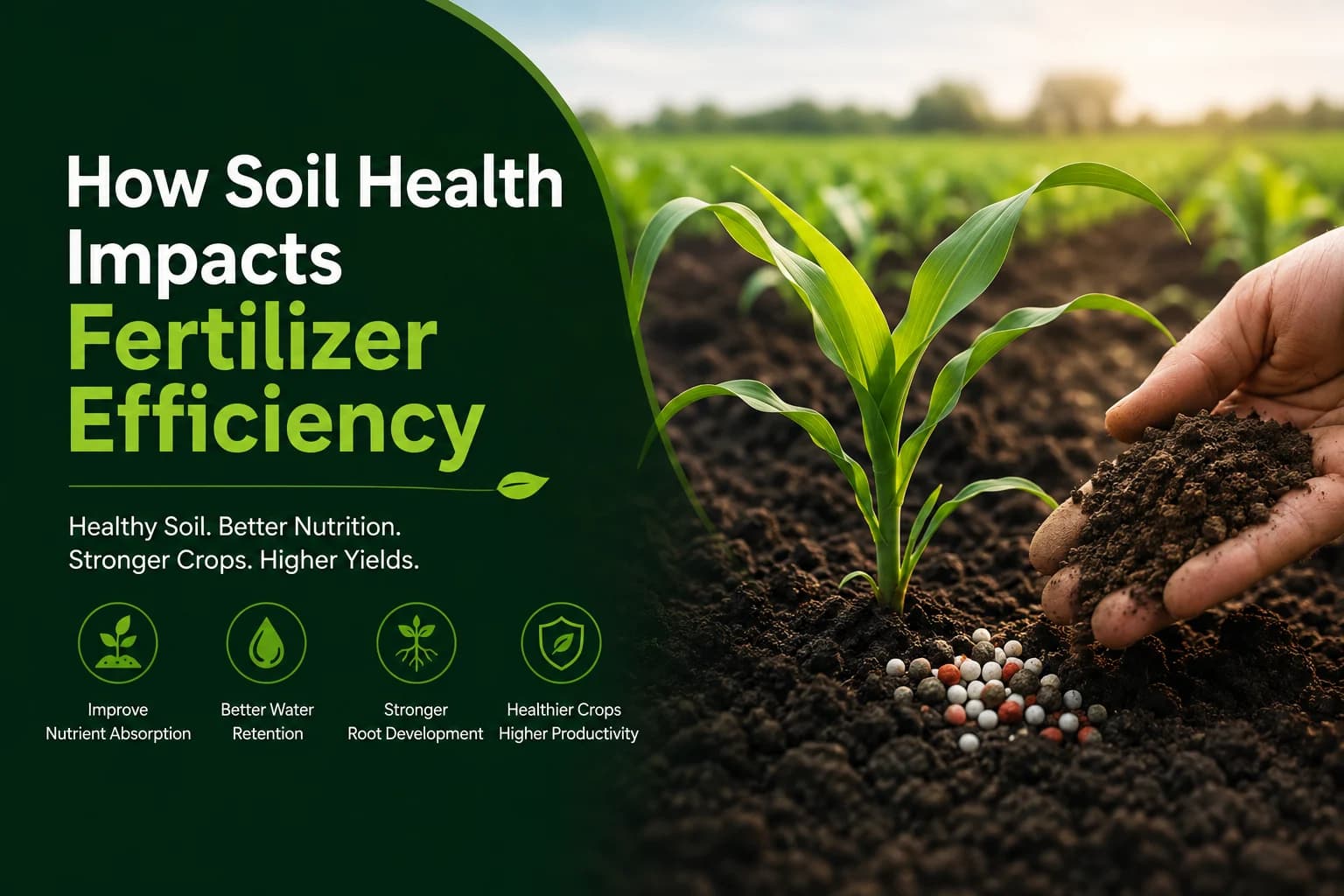
How Soil Health Impacts Fertilizer Efficiency
Healthy soil is the foundation of productive farming. Learn how soil condition, nutrients, organic matter, and proper fertilizer management work together to improve crop growth and farm productivity.
Introduction
Fertilizers provide essential nutrients to crops, but simply adding more fertilizer does not always mean better crop growth. The effectiveness of any fertilizer depends heavily on the condition of the soil. A healthy soil system helps crops absorb nutrients efficiently, retain moisture, support beneficial microorganisms, and develop stronger root systems.
Why Soil Health Matters
Soil is more than just a medium in which plants grow. It is a living ecosystem containing minerals, organic matter, microorganisms, air, and water. Good soil health can help farmers: Improve nutrient availability Increase water retention Promote stronger root development Reduce nutrient loss Improve fertilizer efficiency Support healthier crop growth Maintain long-term soil productivity
Understanding the Three Major Soil Nutrients
Plants require several nutrients, but Nitrogen, Phosphorus, and Potassium are among the most important. 1. Nitrogen (N) Nitrogen supports leaf development and overall plant growth. A nitrogen deficiency can result in pale or yellowish leaves and slow plant development. 2. Phosphorus (P) Phosphorus plays an important role in root development, energy transfer, and flowering. 3. Potassium (K) Potassium helps plants regulate water, strengthen their tissues, and improve resistance to environmental stress.